
Erste Open-Source-Komponenten für die Logistik
Das Jahr 2022 markierte für das Großforschungsprojekt „Silicon Economy Logistics Ecosystem“ (SELE) einen entscheidenden Wendepunkt: Die Vision eines „Linux für die Logistik“ wurde für die Praxis greifbar. Ein zentraler Meilenstein war die Veröffentlichung der ersten Soft- und Hardwarekomponenten im April 2022. Über die digitale Bibliothek der Open Logistics Foundation stellten die beteiligten Forscherinnen und Forscher Ergebnisse aus insgesamt fünf Entwicklungsprojekten als Open Source bereit. Damit wurde das Fundament für ein dezentrales Plattform-Ökosystem gelegt, das Unternehmen ermöglicht, ihre Lieferketten souverän und ohne Abhängigkeit von monopolistischen Plattformen zu digitalisieren.
Auch wissenschaftlich setzte der Lehrstuhl für Unternehmenslogistik (LFO) in diesem Jahr Maßstäbe. Mit dem im Springer-Verlag erschienenen Fachbuch „Silicon Economy“, an dem Univ.-Prof. Dr. habil. Michael Henke als Mitherausgeber maßgeblich mitwirkte, wurde das theoretische und technologische Fundament des Projekts umfassend dokumentiert. Das Werk beleuchtet die Potenziale von Künstlicher Intelligenz (KI) und Blockchain für die Logistik und dient seither als Referenz für die Transformation hin zu föderierten Plattform-Ökonomien.
In der praktischen Anwendung zeigte der LFO im Rahmen der Digitalen Woche Dortmund (#diwodo) im September 2022 Präsenz. Gemeinsam mit den Partnern vom Fraunhofer IML und ISST wurden innovative Lösungen wie der autonome Transportroboter O3dyn und KI-basierte Yard-Management-Systeme einem breiten Publikum vorgestellt. Der Fokus des LFO lag dabei insbesondere auf der Entwicklung logistischer Standardfunktionen sowie der Ausgestaltung technischer Flexibilität in Cloud-Diensten.
Mit dem Leitsatz „Keine Entwicklung ohne Anwendung“ trieb der Lehrstuhl auch 2022 den partizipativen Austausch mit dem Mittelstand voran, um sicherzustellen, dass die entwickelten Open-Source-Lösungen exakt die Bedarfe der industriellen Praxis treffen.
Veröffentlichung des Whitepapers IO4 im Projekt PERSIST
- News
- 2022
- Publikation
- Whitepaper
- Projektergebnis
- PERSIST

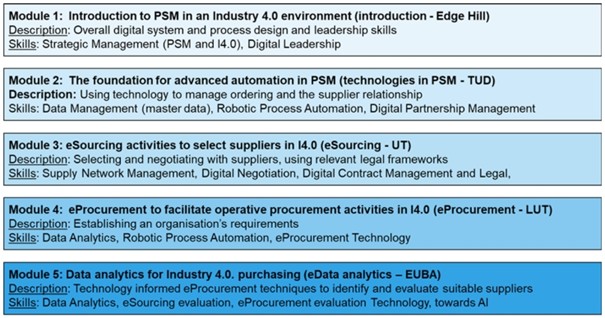
IO4 aims to develop a modular course that can be used within university study programs and professional training to educate future PSM skills in the era of Industry 4.0. The first step in IO4 is developing a course structure in which the results of IO3 can be meaningfully and purposefully integrated. In addition, the course structure reflects a relationship to a practice-based PSM process to generate a high acceptance among educators from different countries and universities. This was used as the basis for developing the overall course structure before analysing what knowledge, skills, and competencies are required in specific modules and how gamification elements can be used to support their delivery meaningfully.
Although the course is modular in structure (see figure below for the structure of the course), an overall storyline was developed to provide orientation for participants and reflect tasks and activities from a real business environment. In addition, this approach ensures that the course is not just a collection of gamified learning objects and this practice focus ensures that the participants are optimally prepared for future tasks and requirements they may face in industrial contexts.